
Europe, alongside China, is a region that is extremely proactive in the adoption of electric vehicles (BEVs = Battery Electric Vehicles). However, skeptical views constantly accompany these trends. For example, particularly in Japan, there is a perspective that the background of Europe's electrification is not fundamentally about environmental issues, but rather because European OEMs (Mercedes-Benz, BMW, Volkswagen, etc.) cannot compete with Japanese OEMs (especially Toyota) in plug-in hybrids, and are therefore attempting to create a game change. People who think this way predict that if Europe forcibly pushes electrification based on distorted motives, a breakdown will inevitably occur somewhere.
Indeed, several moves suggesting such breakdown have been indicated from Europe itself. For example, Volkswagen dismissed CEO Herbert Diess in September 2022, who had been strongly promoting company-wide electrification. Also, at the EU Energy Ministers' meeting held in March 2023, they reversed the policy that completely prohibited new sales of engine vehicles by 2035, and approved continued sales on the condition of using synthetic fuel (e-fuel).
Synthetic fuel is synthesized from hydrogen and carbon dioxide, but generating this hydrogen requires enormous amounts of energy. E-fuel is synthetic fuel made using only hydrogen generated through electrolysis using 100% renewable energy when producing this hydrogen. This logic involves using massive amounts of renewable energy (wind and solar) generated electricity not to directly charge electric vehicle batteries, but to use for electrolysis for hydrogen generation, creating synthetic fuel to power internal combustion engines. Energy efficiency in this case is said to deteriorate by as much as 80% compared to directly charging batteries with renewable energy, according to some calculations. Europe's EV strategy has lowered the flag of complete electrification by 2035 to the extent of tolerating such seemingly "absurd" technology. So will Europe's electric vehicle market expansion lose momentum going forward?
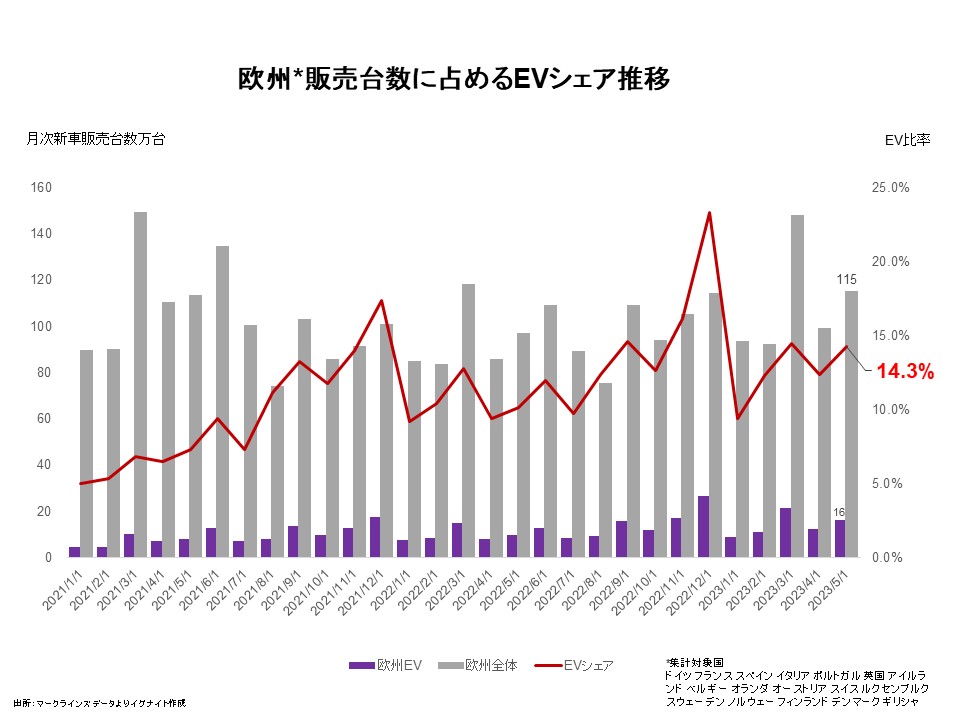
Let us examine the data. The opening graph shows the monthly trend of the ratio of electric vehicles (BEVs only) to new car sales in Europe. At least in the European market since 2021, the following trends are observed:
- Between 2021 and 2023, the proportion of EV sales to total new car sales consistently increased.
- This proportion increased from approximately 5% at the beginning of 2021 to approximately 15% by mid-2023.
- Sales numbers fluctuated dramatically in December 2022 and January 2023.
Among these, the fluctuations from the end of 2022 to the beginning of 2023 are presumed to be the so-called Christmas special demand (year-end special demand) and its reaction. (Since similar movements were observed at the previous year-end, this is probably correct. Even when discarding such irregular movements and looking at the overall trend, the ratio of EV adoption in Europe expanded from 5% to 15% in just two and a half years. *For reference, Japan is currently below 5%, and China is approximately 20%.).
Based on this data alone, it cannot be said that signs of disruption in European EV adoption are showing. On the other hand, it is also true that the sales share, which rapidly grew to 10%, has shown a flattening trend since 2022 with slowing growth. The sales trends during the Christmas shopping season at the end of 2023 will likely be one key point in predicting European EV adoption from 2024 onwards. Ignite will continue to communicate real trends in global automotive market electrification.