
The boxing match of the century is finally approaching. Naoya Inoue, who is said to be the greatest masterpiece in Japanese boxing history. His super bantamweight world title match, where he moves up in weight class, will be held on July 25, 2023. His opponent is Stephen Fulton, the two-division super bantamweight champion. Both fighters are undefeated. And for Inoue, this will be his first time in several years fighting from the blue corner (challenger's side).
Regarding this fight of the century that transcends boxing and attracts sports fans worldwide, an intense preliminary battle has already begun between both camps. At the official press conference on the 22nd, Fulton's camp raised objections about Inoue's hand wrapping technique. While I will leave the details to boxing experts, hand wrapping techniques, combined with taping methods, have different rules that exist for each boxing organization in countries around the world. This time, Fulton's camp's objection is pointing out that Inoue uses a hand wrapping technique (generally believed to increase punching power) that is prohibited under U.S. rules. However, this world championship is being held in Japan, and Fulton's camp is fully aware that Japanese rules will apply. This can ultimately be considered a diversionary tactic. Inoue has fought 4 world championship matches overseas (in the United States and United Kingdom). He naturally followed local rules at those times, and ultimately, boxing fans worldwide know that Inoue achieved KO victories overseas as well.
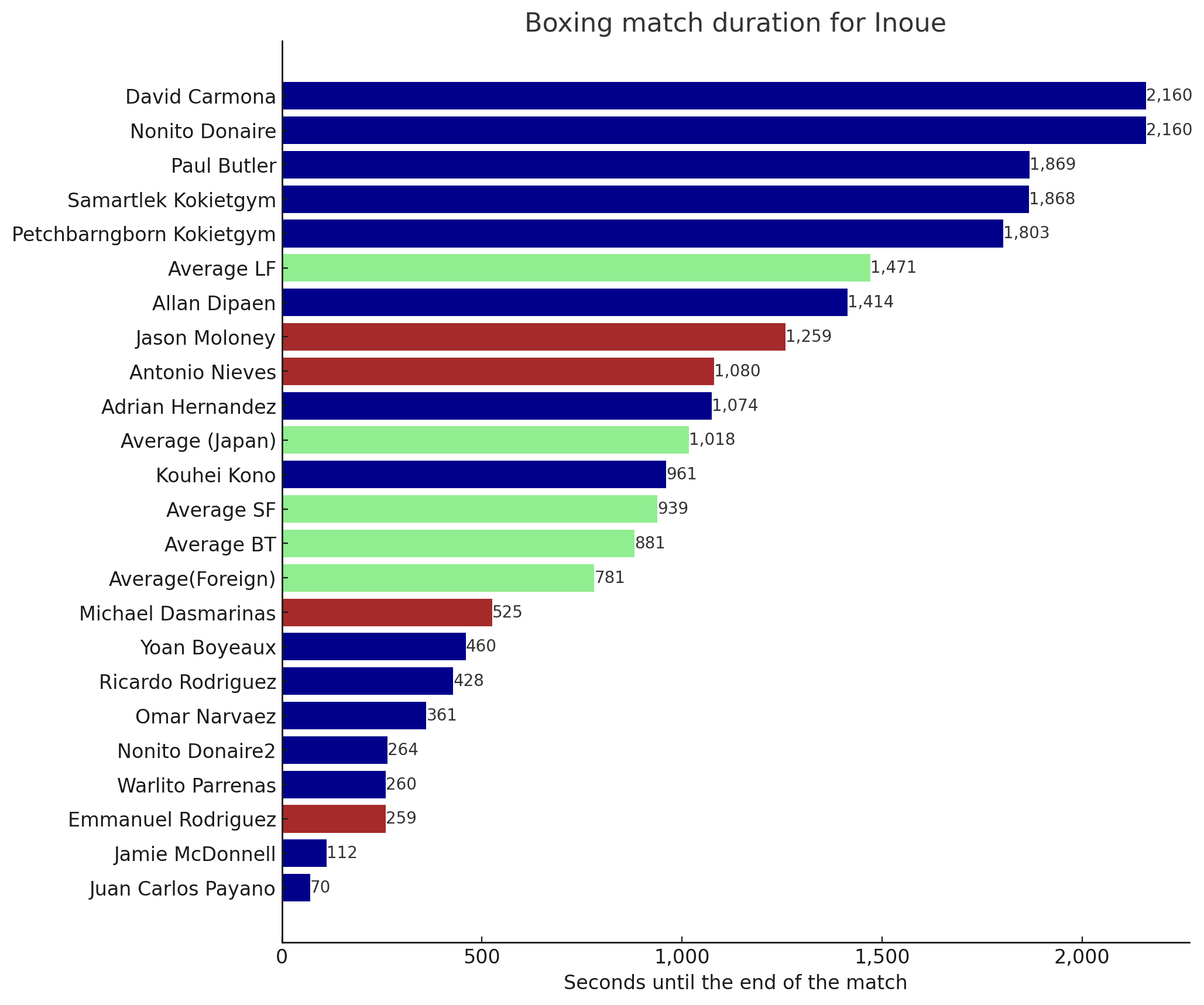
On the other hand, when analyzing Inoue's match results through data analysis, is there any evidence that he struggled more or had longer fights overseas compared to Japan? If so, we cannot deny the possibility that hand wrapping techniques may have some influence on match results. Therefore, I fed ChatGPT, which has been receiving tremendous attention recently, basic data from Inoue's past world championship matches and analyzed it from several angles. The above graph compiles Inoue's world championship match durations (time until the fight ends by KO or decision) in seconds. The longest were two decision matches. The shortest was the Payano fight, which was decided in just 70 seconds. This shocking KO drama is still burned into boxing fans' memories.
Now to the main point. Is there any significant difference between the results of overseas matches and matches in Japan? If Inoue's punching power is affected by different hand wrapping techniques overseas, overseas matches might tend to be prolonged or go to decision. However, the time until fight conclusion (all overseas fights ended in KO/TKO) averages 1,018 seconds for domestic matches, while overseas matches were decided in an average of 781 seconds. Overseas fights were concluded by KO in shorter time periods. Of course, with only 4 overseas matches, the sample size is limited, so this serves merely as one reference point. However, at least past data trends do not suggest that "he struggled overseas because hand wrapping rules differ from Japan."
What about the often-mentioned "weight class barrier" regarding Inoue's challenge moving up in weight class this time? All fans know that Inoue has continued his winning streak without being deterred by weight class barriers. However, looking at the data makes Inoue's strength even more objectively understandable. When I had ChatGPT analyze the average match duration by weight class, match times became shorter as weight classes increased. From light flyweight (LF) to super flyweight (SF), and further to bantamweight (BT). With each weight class increase, the average time for Inoue to finish matches became progressively shorter: 1,471 seconds (LF), 939 seconds (SF), and 881 seconds (BT). At least as a clear trend from past data, it appears that Inoue was more significantly affected by "weight cutting struggles" rather than "weight class barriers." Whether this challenge to super bantamweight will become his first real weight class barrier, or whether his robust physique, continuously evolving through training, will be liberated from weight cutting struggles and unleash Inoue's further hidden power - the world is watching the match on the 25th.
Finally, when I asked ChatGPT to predict the fight based on the data I provided, it responded that "prediction is impossible due to limited data." Indeed, the data used this time included only Inoue's world championship match records, without opponent data or information about total punches thrown and their types. However, I feel there is sufficient possibility that more precise analysis-based predictions could be provided if we could use more abundant datasets in both quantity and quality. With such expectations for the future, I look forward to watching this fight of the century.